

 Generate for Free
 Adobe PDF
 Microsoft Word

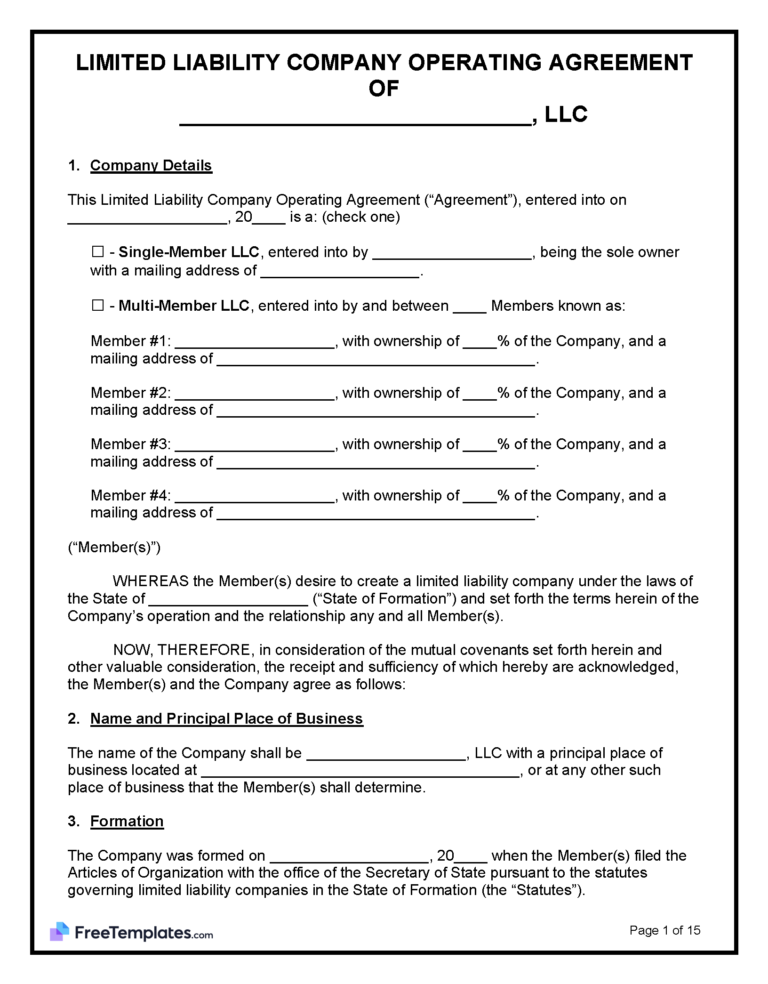
 Generate for Free
 Generate for Free
 Adobe PDF
 Microsoft Word
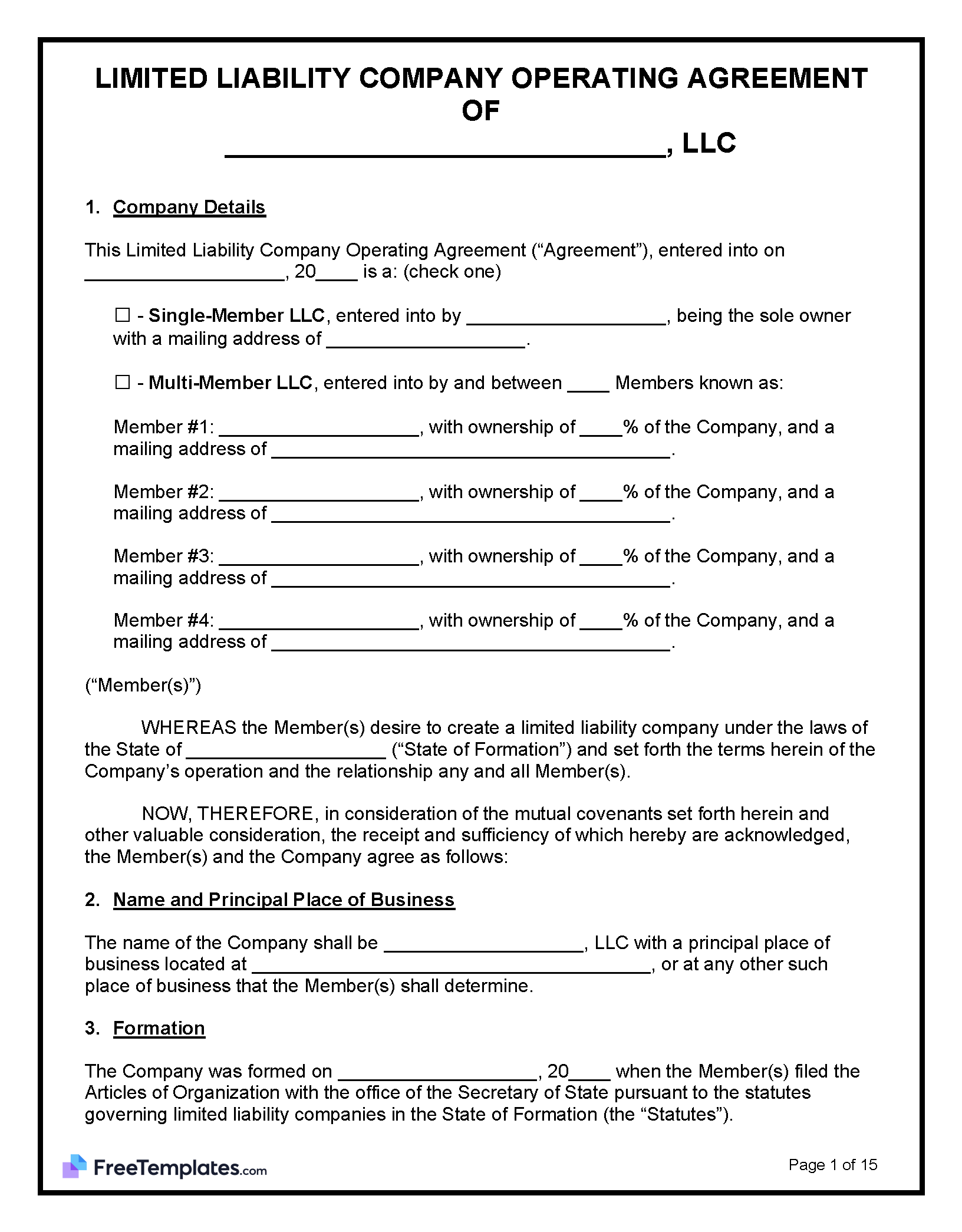
By State
- Alabama
- Alaska
- Arizona
- Arkansas
- California
- Colorado
- Connecticut
- Delaware
- Florida
- Georgia
- Hawaii
- Idaho
- Illinois
- Indiana
- Iowa
- Kansas
- Kentucky
- Louisiana
- Maine
- Maryland
- Massachusetts
- Michigan
- Minnesota
- Mississippi
- Missouri
- Montana
- Nebraska
- Nevada
- New Hampshire
- New Jersey
- New Mexico
- New York
- North Carolina
- North Dakota
- Ohio
- Oklahoma
- Oregon
- Pennsylvania
- Rhode Island
- South Carolina
- South Dakota
- Tennessee
- Texas
- Utah
- Vermont
- Virginia
- Washington
- Washington D.C.
- West Virginia
- Wisconsin
- Wyoming
By Type
Single-Member LLC Operating Agreement – For an LLC with one member.
Multi-Member LLC Operating Agreement – For an LLC with more than one member.
What Should be Included (7 items)
1. Ownership (Members) and Capital Contributions.
All company members (owners) should be listed, along with their ownership percentages. This is most important as there is no other document that mentions the ownership of the company.
LLC Members.
- Member #1’s Name: ______________________
- Mailing Address: ______________________
- Contribution: $____
- Ownership Interest: ____%
- Member #2’s Name: ______________________
- Mailing Address: ______________________
- Contribution: $____
- Ownership Interest: ____%
- Member #3’s Name: ______________________
- Mailing Address: ______________________
- Contribution: $____
- Ownership Interest: ____%
2. Profit Distribution.
Some states, such as Arizona (ARS § 29-3404(A)), by default mention that any distribution “must be in equal shares among members.”
Sample Clause
Profit Distribution. Distributions shall be made pro rata to Members’ ownership percentages, as the Members authorize.
3. Management Structure.
Whether the company is managed by its members or specific managers.
Most states, like Delaware (§ 18-402), by default structure a company to be managed by the members, in accordance with its ownership percentage.
Sample Clause
Management. The Company shall be (check one):
☐ – Member-Managed. The Members manage the Company, and each Member may bind it in the ordinary course of business.
☐ – Manager-Managed. The Manager(s), ______________________, have exclusive authority to manage and bind the Company.
4. Voting, Approvals, and Major Decisions.
Most states, like New York (§ 34-4-402), have by default that each Member’s vote shall count in equal proportion to their ownership interest, and that a majority (more than 50%) rules for all decisions.
Sample Clause
Voting. Members vote (check one): ☐ by Percentage Interest ☐ one vote per Member.
Approvals. Decisions require (check one): ☐ a majority ☐ ____% ☐ unanimous consent of the votes.
Major Decisions. Selling substantially all assets, borrowing over $________, admitting a Member, or amending this Agreement requires (check one): ☐ a majority ☐ ____% ☐ unanimous consent.
5. Ownership Transfer.
A section should cover what would happen in the event of a member’s death, disability, bankruptcy, voluntary exit, and the right to sell to a third party.
In some states, such as Delaware (§ 18-702), by default, if a member assigns their ownership interest to someone else, the assignee obtains the economic rights, but no rights to vote or actively manage the entity.
Sample Clause
Ownership Transfer. An assignee of a membership interest receives (check one): ☐ Economic-rights only or ☐ Full Membership Rights.
6. Fiduciary Duties.
Determines whether the members or managers have a fiduciary duty to the company, and defines the types of activity that are allowed.
In every state, fiduciary duties exist by default for the managing members of the entity. No loyalty exists for non-managing members (§ 409 – RULLCA).
Sample Clause
Fiduciary Duties. The duties of loyalty and care to the Company shall be owed by (check one):
☐ – All Members and Managers.
☐ – Only Managers and Members who participate in managing the Company.
7. Indemnification.
Requires the LLC to pay or reimburse members and managers for good-faith actions on behalf of the company that resulted in legal or financial liability (e.g., a customer gets food poisoning and sues the member who made the meal, not the LLC).
In some states, such as Texas (§ 101.402), the law states an LLC “may” indemnify a person. This means an entity is simply allowed to indemnify a member, but not required to do so.
The main issue is not only the company paying for the judgment and settlement, but also covering the legal expenses if a member is personally sued.
Sample Clause
Indemnification. The Company shall indemnify each Member and Manager against any loss, liability, or expense, including attorneys’ fees as incurred, arising from good-faith actions on behalf of the Company, except in cases of fraud, bad faith, gross negligence, or willful misconduct.
Frequently Asked Questions (FAQs)
Does it need to be notarized?
No, obtaining a member’s signature (physically or digitally) constitutes a legally-binding document.
Do all members need to sign?
It is highly recommended that all members sign, but it is not required.
However, if there are obligations to members, such as non-compete provisions or restrictive covenants, it is recommended that all members authorize the operating agreement.
Does an agreement protect against personal liability?
Yes, but with conditions. If a creditor argues that an LLC is being run no differently from a personal asset, the creditor will check to ensure the members are honoring the terms of the operating agreement.
If the members are running the company in the exact manner outlined, the operating agreement helps protect them and shield their personal assets from liability.
Does it include ownership interest?
Yes, an operating agreement is the primary place where ownership is recorded for the entity. There is no government agency that records this, and it is usually confirmed in the member’s K-1 filing with the IRS.
Does the company need to run in accordance with an operating agreement?
Yes, it must run in accordance with the operating agreement to allocate liability among members and to limit exposure to third parties claiming the LLC is not a separate entity from personal assets.
Are “shares” issued in an LLC?
Does it need to be filed anywhere?