
Signing Requirements
The principal must sign the document or direct another individual to sign in their conscious presence. The signature must be acknowledged before a notary public or another individual authorized by law to take acknowledgments. No additional witnesses are required.
Source: NCGS § 32C-1-105
“Durable” Definition
With respect to a power of attorney, the incapacity of the principal does not terminate the power of attorney.
Source: N.C. Gen. Stat. § 32C-1-102(2)
Powers Granted
- Real Property;
- Tangible Personal Property;
- Stocks and Bonds;
- Commodities and Options;
- Banks and Other Financial Institutions;
- Operation of Entity or Business;
- Insurance and Annuities;
- Estates, Trusts, and Other Beneficial Interests;
- Claims and Litigation;
- Personal and Family Maintenance;
- Benefits from Governmental Programs or Civil or Military Service;
- Retirement Plans; and
- Taxes.
Source: NCGS § 32C-3-301
Termination
A North Carolina durable power of attorney may be revoked or terminated through:
- The principal dies;
- The principal revokes an unrecorded document through an executed written revocation or by intentionally destroying it; a registered document requires a recorded revocation and service on the agent;
- An expiration date or another termination condition specified in the document occurs;
- The purpose of the power of attorney is accomplished;
- The agent’s authority is revoked, or the agent dies, resigns, or becomes incapacitated, and no other agent is authorized to act; or
- A guardian of the principal’s estate or general guardian terminates the document.
Source: N.C.G.S. § 32C-1-110
Statutory Form
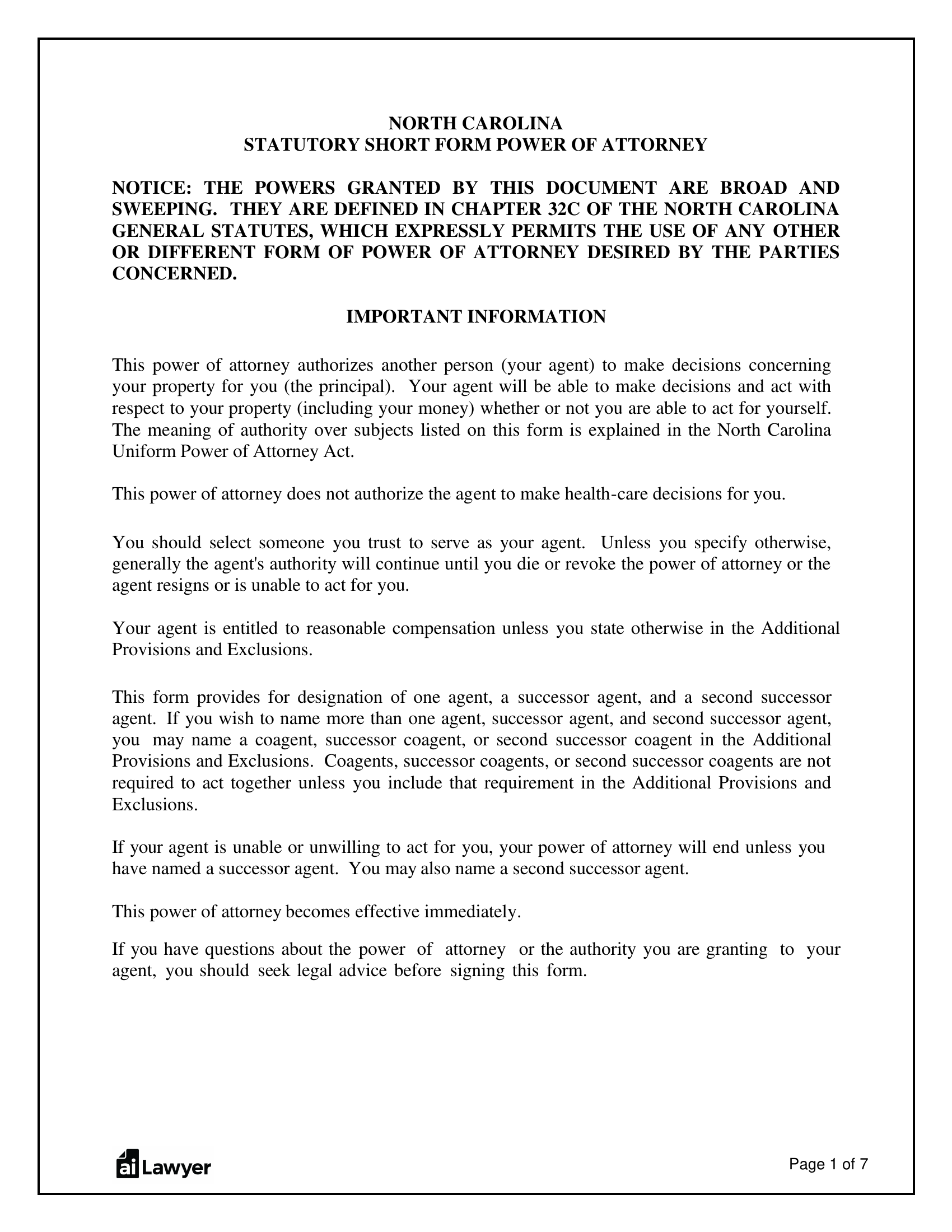
Yes, North Carolina authorizes a Statutory Short Form Power of Attorney.
Source: NCGS § 32C-3-301
Sample
North Carolina Durable (Statutory) Power of Attorney Form · sample
Open PDF
North Carolina Durable (Statutory) Power of Attorney Form
Free AI Generator