
Signing Requirements
The principal must sign the document and acknowledge their signature before a notary public. The signing must also be witnessed by two adults, who must sign in the presence of the principal and each other.
Source: Estates and Trusts § 17-110
“Durable” Definition
When a principal designates another as an attorney in fact or agent by a power of attorney in writing, it is a durable power of attorney unless otherwise provided by its terms.
Powers Granted
- Real property;
- Tangible personal property, including motor vehicles, boats, planes, and other titled and untitled tangible personal property;
- Stocks and bonds;
- Banks and other financial institutions;
- Insurance and annuities;
- Claims and litigation;
- Benefits from governmental programs or civil or military service;
- Retirement plans;
- Taxes;
- Digital assets;
- Trust and estate matters; and
- Disclaimers of property interests.
Source: Estates and Trusts § 17-202
Termination
A Maryland durable power of attorney is terminated if:
- The principal dies;
- The principal revokes the document;
- An expiration date or another specified termination event occurs;
- The purpose of the power of attorney is accomplished; or
- The agent’s authority is revoked, or the agent dies, resigns, or becomes incapacitated, and no other agent is authorized to act.
Source: Estates & Trusts § 17-112, § 17-105(e)
Statutory Form
Yes, Maryland has a Statutory Form Personal Financial Power of Attorney.
Source: Estates and Trusts § 17-202
Sample
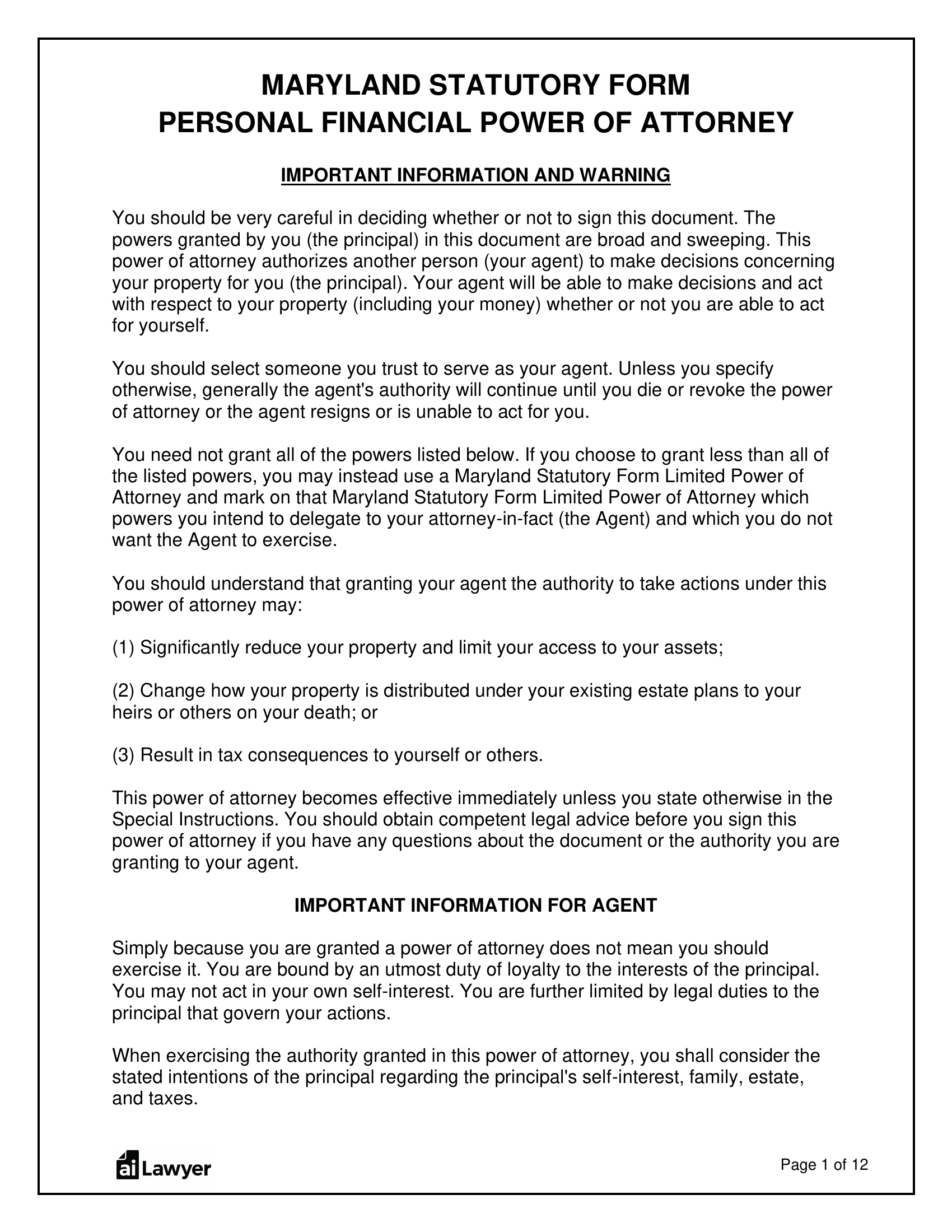
Maryland Durable (Statutory) Power of Attorney Form · sample
Open PDF
Maryland Durable (Statutory) Power of Attorney Form
Free AI Generator