
Signing Requirements
For a Colorado power of attorney, the principal may sign personally or direct another individual to sign in their conscious presence. A notary public is not required for general execution. Having the signature acknowledged is still helpful because the law then presumes it is genuine.
Source: CRS § 15-14-705
“Durable” Definition
A power of attorney created on and after January 1, 2010, is durable unless it expressly provides that it is terminated by the incapacity of the principal.
Source: C.R.S. § 15-14-704(1)
Powers Granted
- Real property;
- Tangible personal property;
- Stocks and bonds;
- Commodities and options;
- Banks and other financial institutions;
- Operation of entity or business;
- Insurance and annuities;
- Estates, trusts, and other beneficial interests;
- Claims and litigation;
- Personal and family maintenance;
- Benefits from governmental programs or civil or military service;
- Retirement plans; and
- Taxes.
Source: C.R.S. § 15-14-741
Termination
A durable power of attorney in Colorado terminates upon:
- The principal dies;
- The principal revokes the power of attorney;
- The document reaches its stated expiration date or another specified termination event occurs;
- The express purpose of the power of attorney is accomplished; or
- The principal revokes the agent’s authority, or the agent dies, becomes incapacitated, or resigns, and no other agent is authorized to act.
Source: C.R.S. § 15-14-710
Statutory Form
Yes, Colorado law sets out a financial power of attorney form.
Source: C.R.S. § 15-14-741
Sample
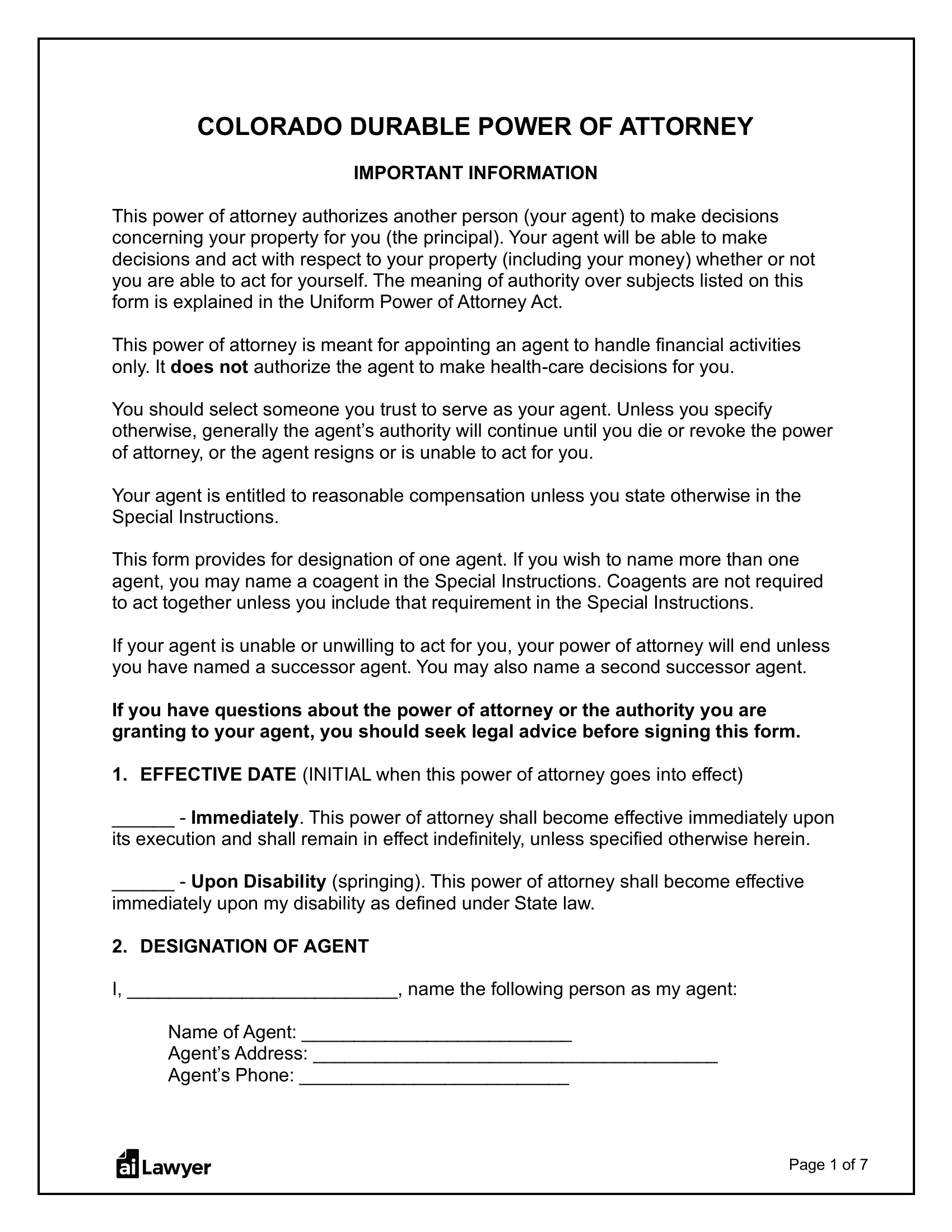
Colorado Durable (Statutory) Power of Attorney Form · sample
Open PDF
Colorado Durable (Statutory) Power of Attorney Form
Free AI Generator