
Signing Requirements
The principal must sign the document or direct another individual to sign in their conscious presence. A notary public is not generally required for execution, although notarization is recommended.
Source: 14 V.S.A. § 4005, § 4051
“Durable” Definition
“Durable,” with respect to a power of attorney, means not terminated by the principal’s incapacity or unavailability.
Source: 14 V.S.A. § 4002(2)
Powers Granted
- Real Property;
- Tangible Personal Property;
- Stocks and Bonds;
- Commodities and Options;
- Banks and Other Financial Institutions;
- Operation of Entity or Business;
- Insurance and Annuities;
- Estates, Trusts, and Other Beneficial Interests;
- Claims and Litigation;
- Personal and Family Maintenance;
- Benefits from Governmental Programs or Civil or Military Service;
- Retirement Plans; and
- Taxes.
Source: 14 V.S.A. § 4051
Termination
A Vermont durable power of attorney may be terminated upon:
- The principal dies;
- The principal revokes the document before being determined incapacitated;
- An expiration date or another termination condition specified in the document occurs;
- The purpose of the power of attorney is accomplished; or
- The agent’s authority is revoked, or the agent dies, resigns, becomes incapacitated or unavailable, and no other agent is authorized to act.
Source: 14 V.S.A. § 4010
Statutory Form
Yes, Vermont law contains a Statutory Form Power of Attorney.
Source: 14 V.S.A. § 4051
Sample
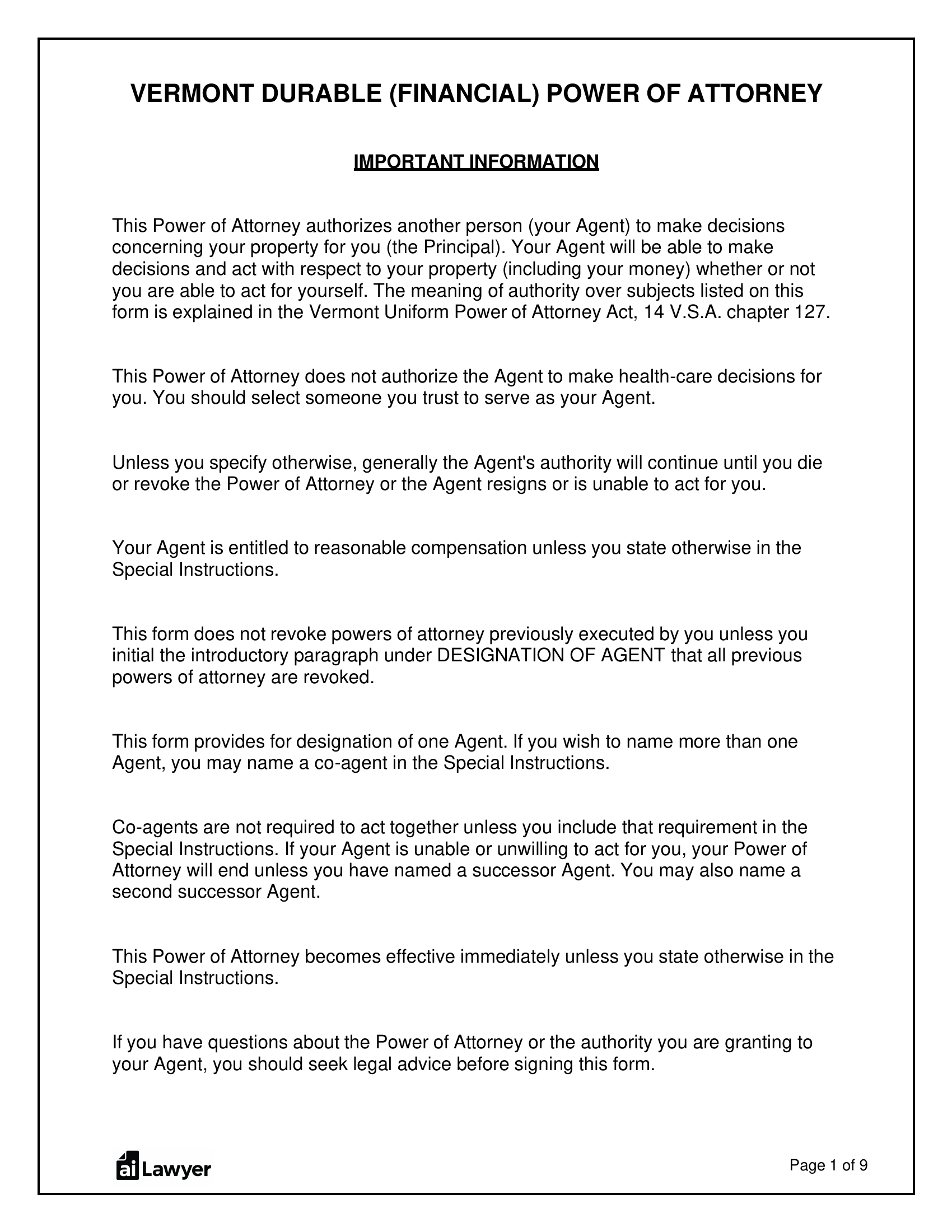
Vermont Durable (Statutory) Power of Attorney Form · sample
Open PDF
Vermont Durable (Statutory) Power of Attorney Form
Free AI Generator