
Signing Requirements
South Dakota requires the principal to sign, or direct another person to sign in their conscious presence, and have the signature acknowledged before a notary public or another individual authorized to take acknowledgments.
Source: SDCL § 59-12-4
“Durable” Definition
“Durable,” not terminated by the principal’s incapacity;
Source: S.D. Codified Laws § 59-12-1(2)
Powers Granted
- Real Property;
- Tangible Personal Property;
- Stocks and Bonds;
- Commodities and Options;
- Banks and Other Financial Institutions;
- Operation of Entity or Business;
- Insurance and Annuities;
- Estates, Trusts, and Other Beneficial Interests;
- Claims and Litigation;
- Personal and Family Maintenance;
- Benefits from Governmental Programs or Civil or Military Service;
- Retirement Plans; and
- Taxes.
Source: SDCL § 59-12-41
Termination
South Dakota recognizes the following causes of termination:
- The principal dies;
- The principal revokes the power of attorney;
- An expiration date or another termination condition specified in the document occurs;
- The purpose of a limited or special power of attorney is accomplished;
- The agent’s authority is revoked, or the agent dies, resigns, or becomes incapacitated, without another agent authorized to act; or
- A court-appointed conservator or other qualifying fiduciary assumes responsibility for the principal’s property, unless the court orders otherwise.
Source: SDCL § 59-12-9, § 59-12-7
Statutory Form
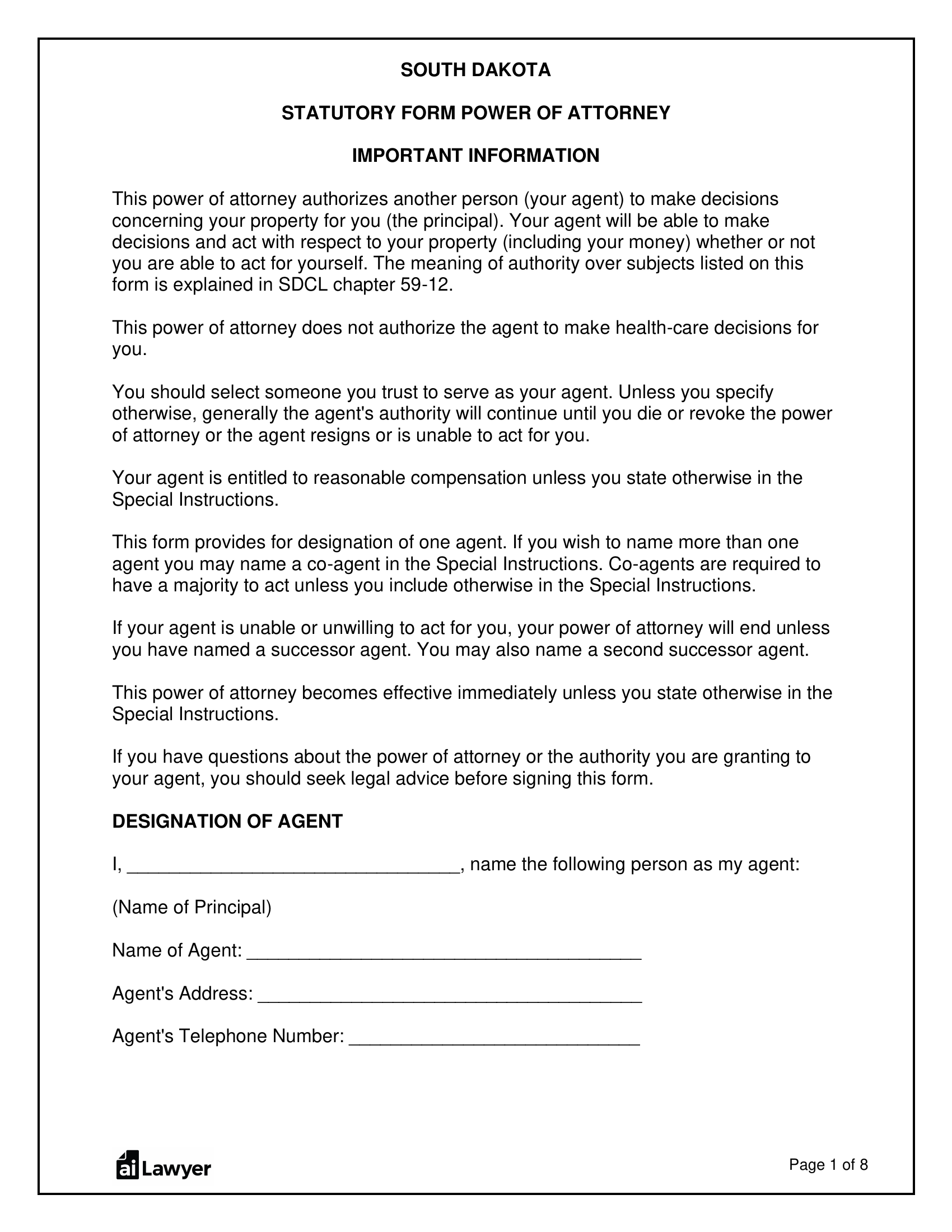
Yes, South Dakota provides a Statutory Form Power of Attorney.
Source: SDCL § 59-12-41
Sample
South Dakota Durable (Statutory) Power of Attorney Form · sample
Open PDF
South Dakota Durable (Statutory) Power of Attorney Form
Free AI Generator