
Signing Requirements
The principal may sign or direct someone else to sign in their conscious presence without mandatory witnesses or notarization. A notary public is useful because an acknowledged signature is presumed genuine.
Source: ORC § 1337.25, § 1337.01, § 1337.04
“Durable” Definition
“Durable,” with respect to a power of attorney, means not terminated by the principal’s incapacity.
Source: Ohio Rev. Code § 1337.22(B)
Powers Granted
- Real Property;
- Tangible Personal Property;
- Stocks and Bonds;
- Commodities and Options;
- Banks and Other Financial Institutions;
- Operation of Entity or Business;
- Insurance and Annuities;
- Estates, Trusts, and Other Beneficial Interests;
- Claims and Litigation;
- Personal and Family Maintenance;
- Benefits from Governmental Programs or Civil or Military Service;
- Retirement Plans;
- Taxes; and
- Digital Assets.
Source: ORC § 1337.60
Termination
In Ohio, a durable power of attorney terminates upon:
- The principal dies;
- The principal revokes the power of attorney;
- The document reaches its stated expiration date or another specified termination event occurs;
- The purpose of the power of attorney is accomplished; or
- The principal revokes the agent’s authority, or the agent dies, resigns, or becomes incapacitated, and no other agent is authorized to act.
Source: O.R.C. § 1337.30
Statutory Form
Yes, Ohio provides a statutory form covering financial and property matters.
Source: ORC § 1337.60
Sample
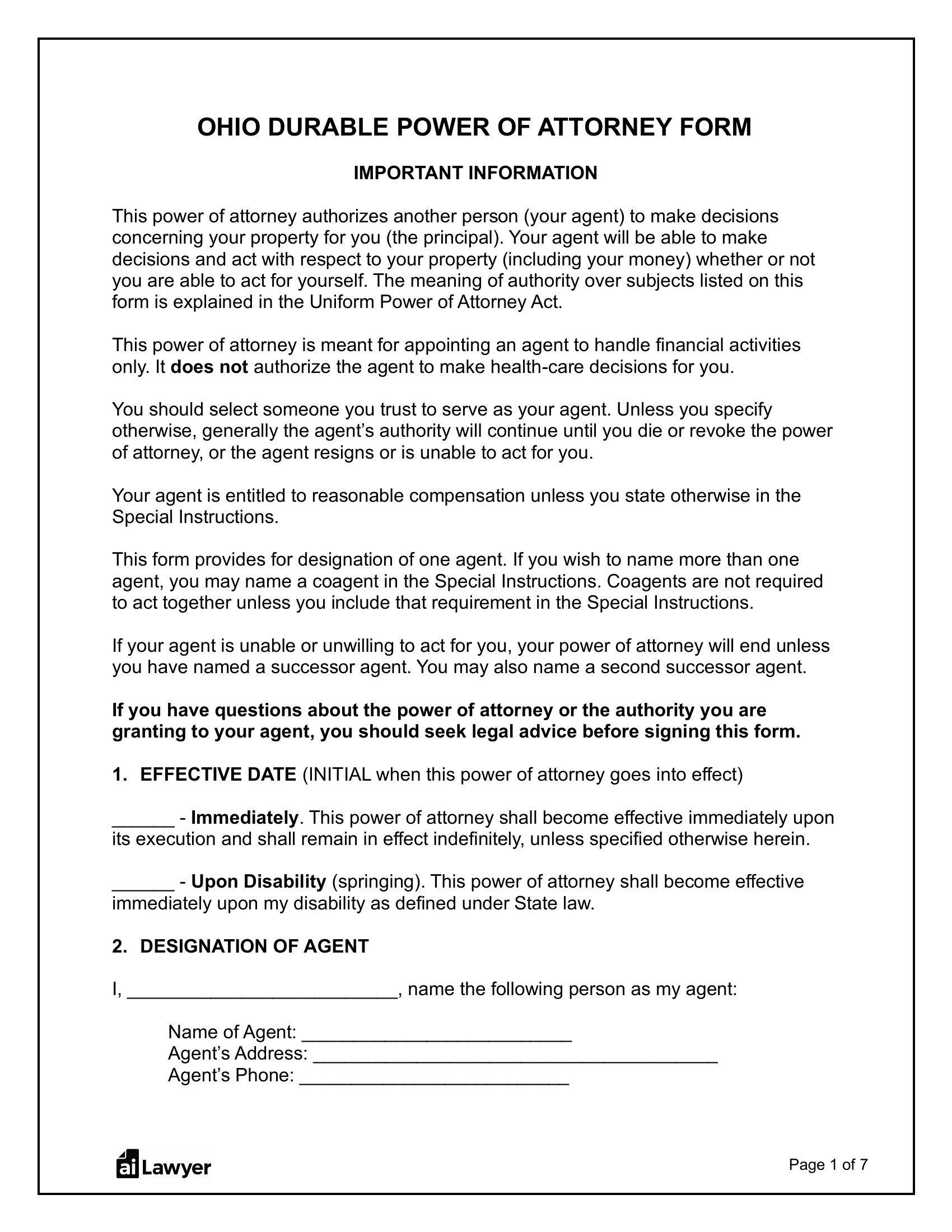
Ohio Durable (Statutory) Power of Attorney Form · sample
Open PDF
Ohio Durable (Statutory) Power of Attorney Form
Free AI Generator