
Signing Requirements
The form must be signed and acknowledged before a notary public or another authorized officer, with the required signed disclosure attached. The agent must also sign and attach an acknowledgment of their responsibilities before exercising any authority.
“Durable” Definition
“Durable,” with respect to a power of attorney, means not terminated by the principal’s incapacity.
Source: N.H. Rev. Stat. § 564-E:102(4)
Powers Granted
- Real Property as defined in RSA 564-E:204;
- Tangible Personal Property as defined in RSA 564-E:205;
- Stocks and Bonds as defined in RSA 564-E:206;
- Commodities and Options as defined in RSA 564-E:207;
- Banks and Other Financial Institutions as defined in RSA 564-E:208;
- Operation of Entity or Business as defined in RSA 564-E:209;
- Insurance and Annuities as defined in RSA 564-E:210;
- Estates, Trusts and Other Beneficial Interests as defined in RSA 564-E:211;
- Claims and Litigation as defined in RSA 564-E:212;
- Personal and Family Maintenance as defined in RSA 564-E:213;
- Benefits from Governmental Programs or Civil or Military Service as defined in RSA 564-E:214;
- Retirement Plans as defined in RSA 564-E:215;
- Taxes as defined in RSA 564-E:216; and
- Digital Assets as defined in RSA 554-A:2(10).
Source: RSA 564-E:301
Termination
A New Hampshire durable power of attorney ends in these situations:
- The principal dies;
- The principal revokes the power of attorney;
- An expiration date or another termination condition specified in the document takes effect;
- The purpose of the power of attorney is accomplished; or
- The agent’s authority is revoked, or the agent dies, resigns, or becomes incapacitated, without another agent authorized to serve.
Source: RSA 564-E:110, RSA 564-E:108
Statutory Form
Yes, New Hampshire includes a model power of attorney form in its statutes.
Source: RSA 564-E:301
Sample
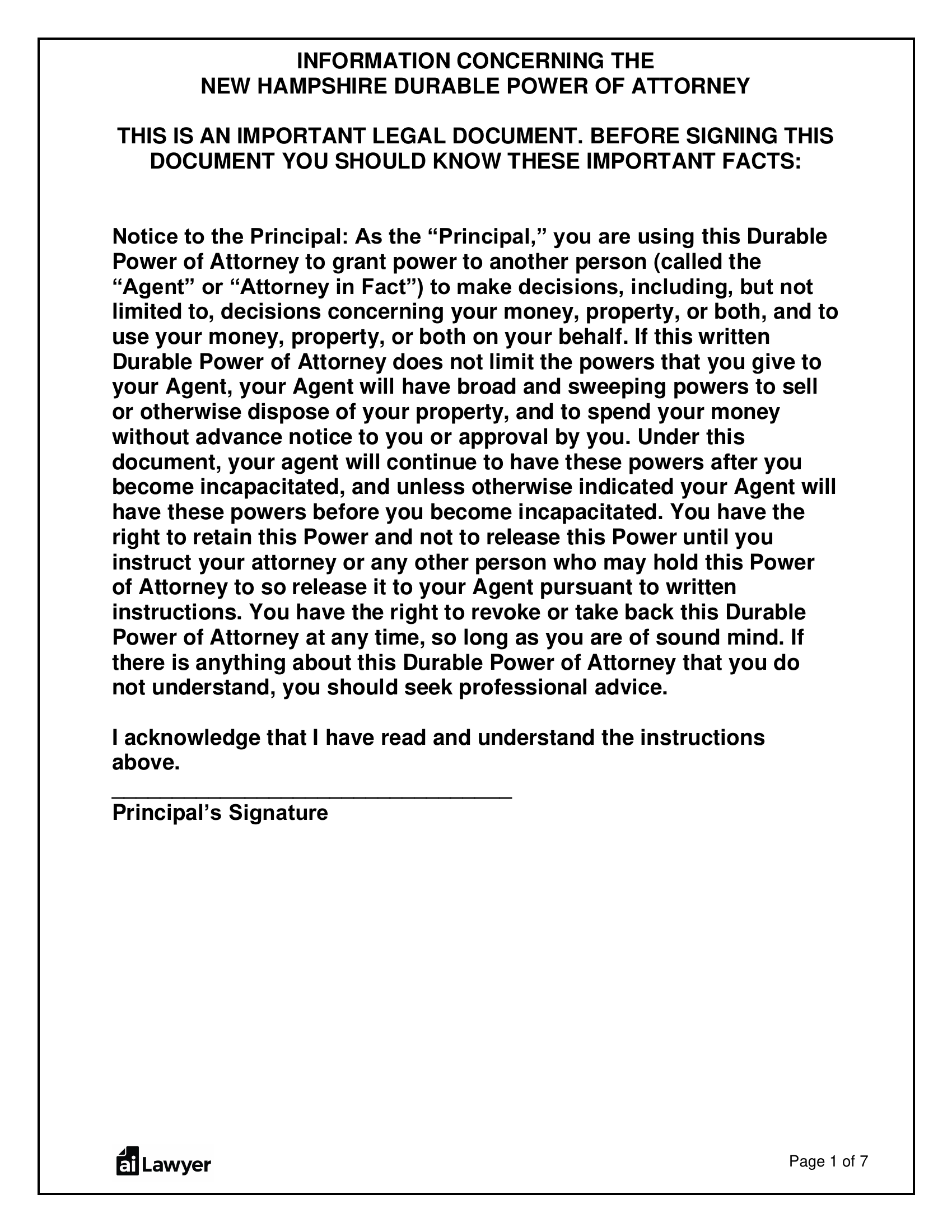
New Hampshire Durable (Statutory) Power of Attorney Form · sample
Open PDF
New Hampshire Durable (Statutory) Power of Attorney Form
Free AI Generator