
Signing Requirements
A Kentucky principal may sign the power of attorney personally or have someone else sign at their direction and in their conscious presence. If another person signs, the document must explain why. A notary public is not generally required, though acknowledgment helps establish legitimacy.
Source: KRS § 457.050
“Durable” Definition
A power of attorney created under this chapter is durable unless it expressly provides that it is terminated by the incapacity of the principal.
Source: K.R.S. § 457.040
Powers Granted
- Real Property;
- Tangible Personal Property;
- Stocks and Bonds;
- Commodities and Options;
- Banks and Other Financial Institutions;
- Operation of Entity or Business;
- Insurance and Annuities;
- Estates, Trusts, and Other Beneficial Interests;
- Claims and Litigation;
- Personal and Family Maintenance;
- Benefits from Governmental Programs or Civil or Military Service;
- Retirement Plans; and
- Taxes.
Source: KRS § 457.420
Termination
A Kentucky durable power of attorney ends in the following circumstances:
- The principal dies;
- The principal revokes the power of attorney;
- A court appoints a conservator, guardian, or other qualifying fiduciary to manage the principal’s property, unless the court specifically allows the power of attorney to remain effective;
- The document expires or another stated termination condition occurs;
- The purpose of the power of attorney is accomplished; or
- The agent’s authority is revoked, or the agent dies, resigns, or becomes incapacitated, without another agent available to act.
Source: KRS § 457.100
Statutory Form
Yes, Kentucky law contains a form for delegating financial authority.
Source: KRS § 457.420
Sample
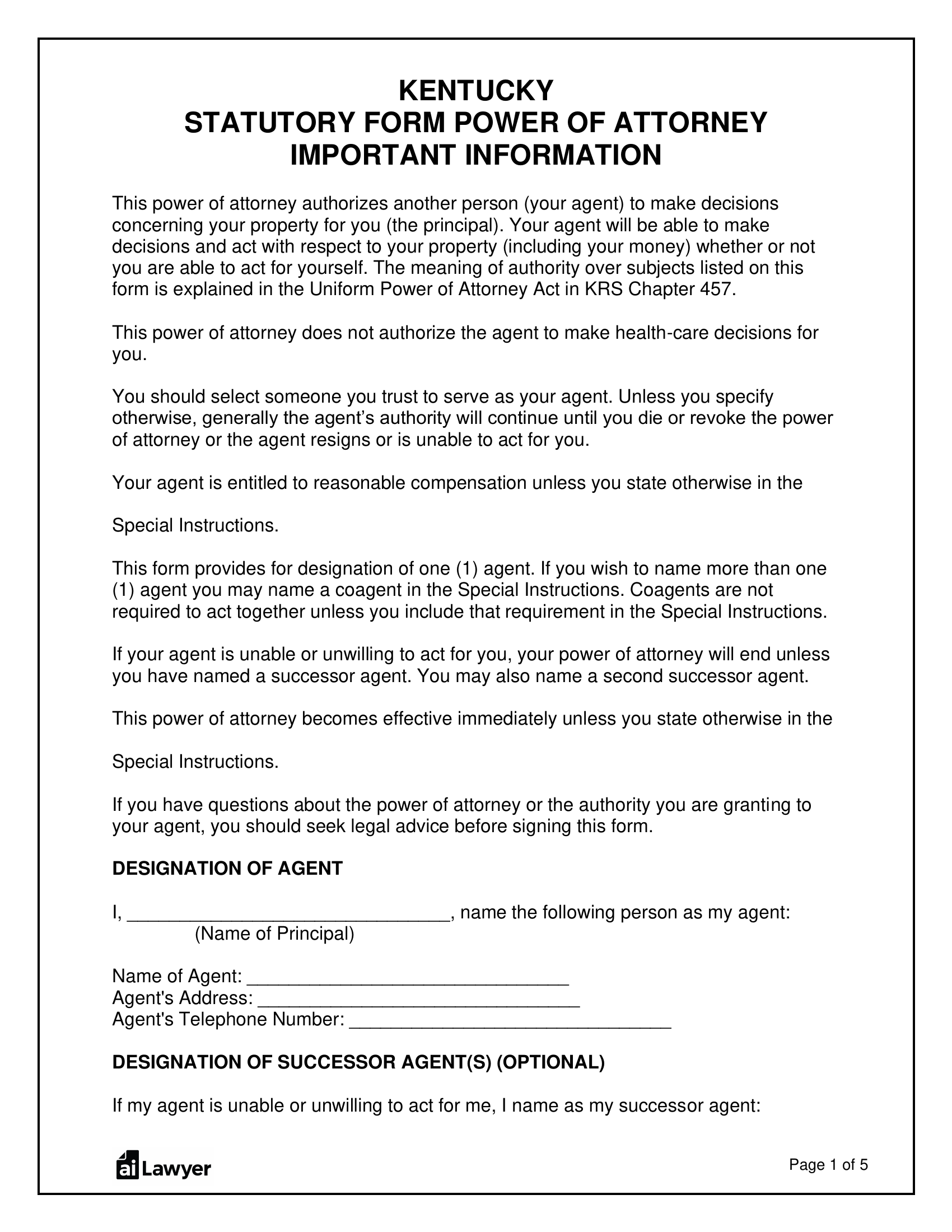
Kentucky Durable (Statutory) Power of Attorney Form · sample
Open PDF
Kentucky Durable (Statutory) Power of Attorney Form
Free AI Generator