
Signing Requirements
California has different signing rules depending on the form used. The uniform statutory form requires the principal’s signature to be acknowledged before a notary public. A nonstatutory power of attorney may instead be signed before two adult witnesses, neither of whom may be the agent.
Source: Probate Code § 4402, § 4121, § 4122
“Durable” Definition
This power of attorney shall not be affected by subsequent incapacity of the principal.
Source: Cal. Prob. Code § 4124(a)
Powers Granted
- Real property transactions;
- Tangible personal property transactions;
- Stock and bond transactions;
- Commodity and option transactions;
- Banking and other financial institution transactions;
- Business operating transactions;
- Insurance and annuity transactions;
- Estate, trust, and other beneficiary transactions;
- Claims and litigation;
- Personal and family maintenance;
- Benefits from Social Security, Medicare, Medicaid, or other governmental programs, or civil or military service;
- Retirement plan transactions; and
- Tax matters.
Source: Probate Code § 4401
Termination
California allows a durable power of attorney to be terminated in these circumstances:
- The principal revokes the power of attorney in writing or by a method the document provides;
- The document expires or another stated termination condition occurs;
- The purpose of the power of attorney is completed;
- The principal dies, except for specific authority permitted by law to continue after death;
- The agent dies, resigns, is removed, or becomes incapacitated, ending that agent’s authority; or
- The principal’s marriage to the agent is dissolved or annulled, revoking the former spouse’s appointment.
Source: Prob. Code § 4151, Prob. Code § 4152, Prob. Code § 4153, Prob. Code § 4154
Statutory Form
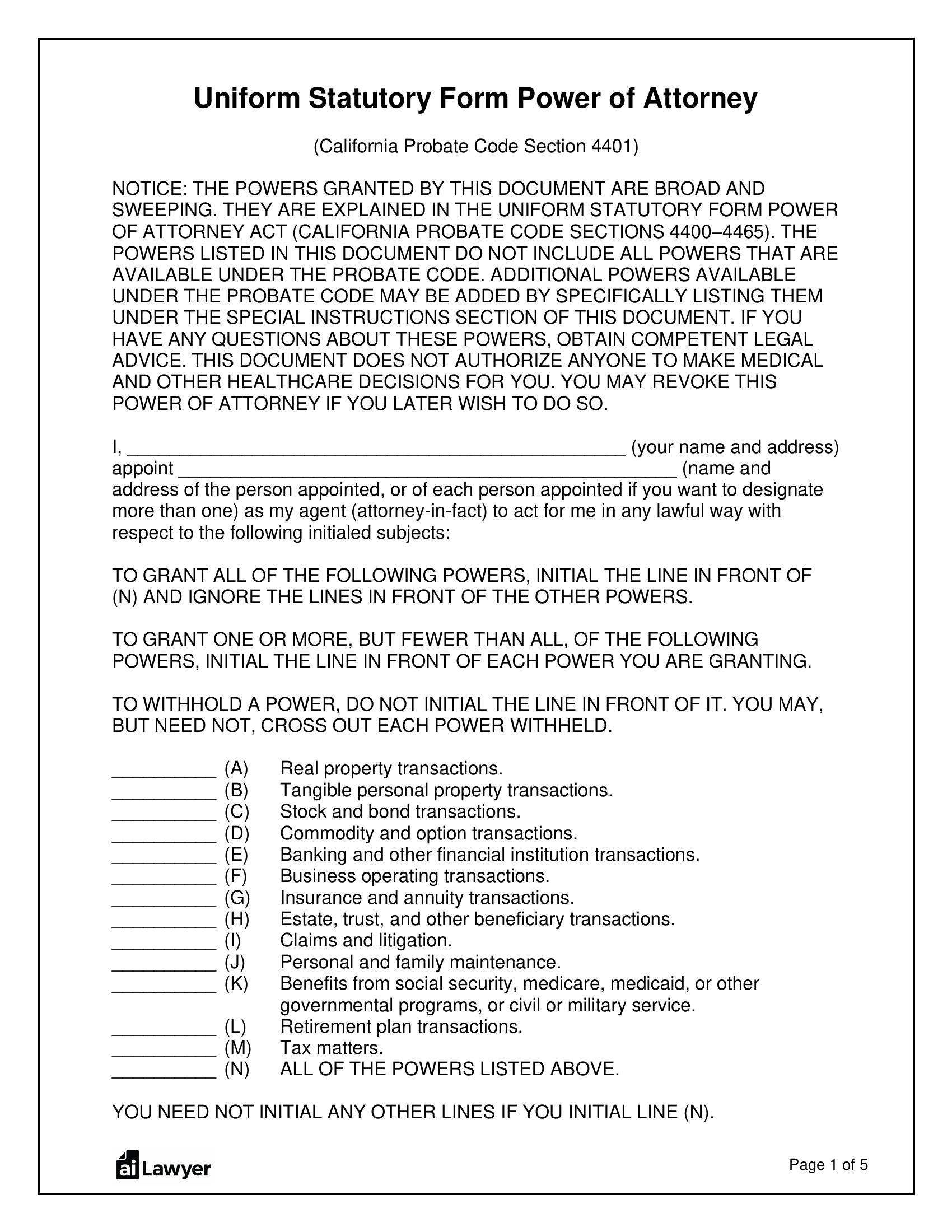
Yes, California provides a Uniform Statutory Form Power of Attorney.
Source: Probate Code § 4401
Sample
California Durable (Statutory) Power of Attorney Form · sample
Open PDF
California Durable (Statutory) Power of Attorney Form
Free AI Generator